
Direct answer
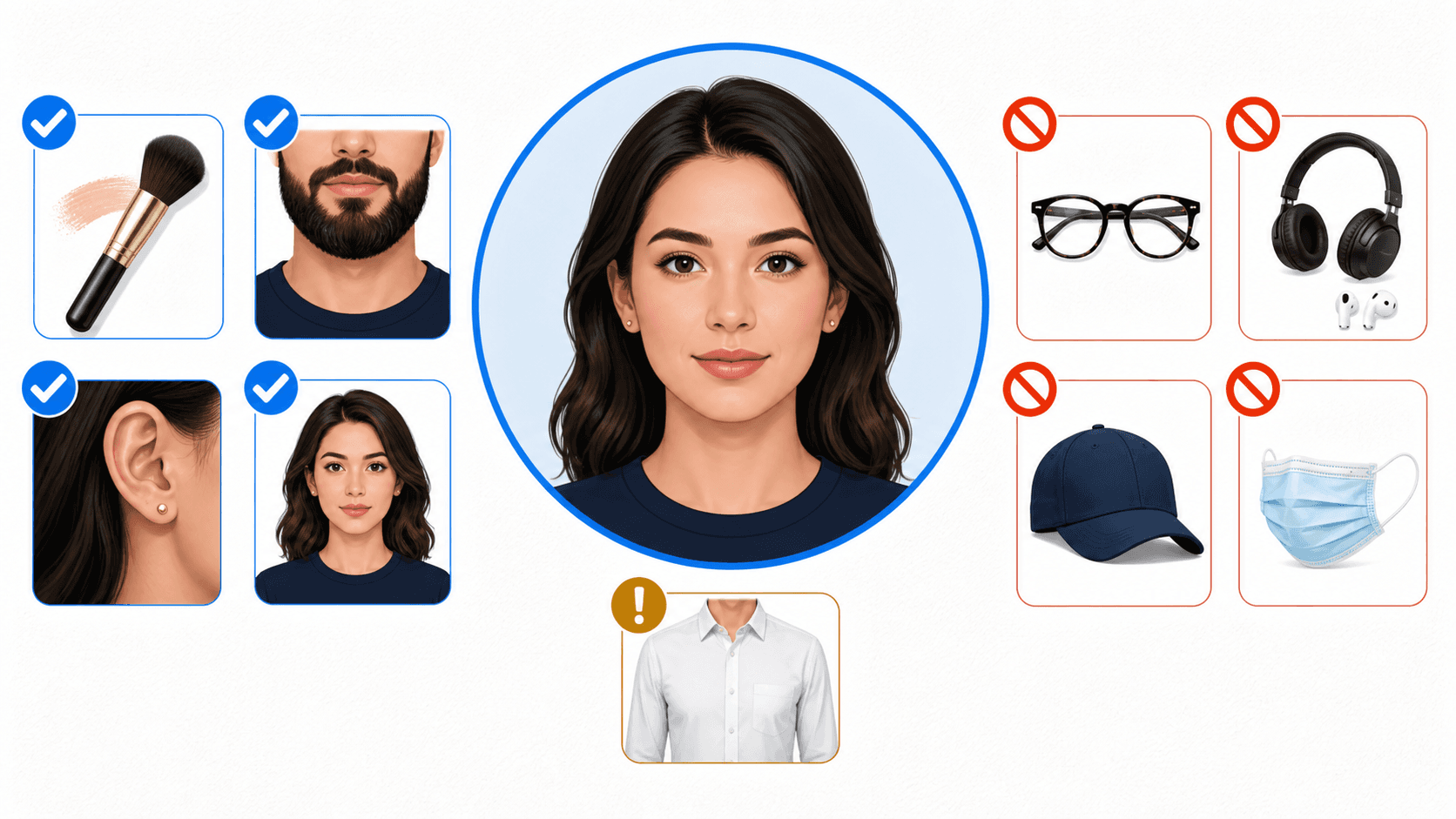
Makeup, beards, facial piercings, and jewelry are all fine in a U.S. passport photo, with one governing test: your face must remain clearly visible, and the photo must look like you as you normally appear. What must come off regardless: eyeglasses, sunglasses, hats, headphones, and face coverings, with narrow documented exceptions for medical and religious cases. And nothing may be fixed digitally afterward — the photo is an identity document, not a portrait.
The quick reference
| Item | Allowed? | Watch out for |
|---|---|---|
| Everyday makeup | Yes | Should match your normal appearance |
| Heavy contouring, glitter, dramatic shine | Risky | Can change the apparent shape of your face or cause glare |
| Beard or mustache | Yes | No need to shave; just be current |
| Earrings and necklaces | Yes | Glare and shadows from large or shiny pieces |
| Facial piercings | Yes | Must not hide facial features |
| Visible tattoos | Yes | No restriction; they are part of your appearance |
| Wig or hairpiece worn daily | Yes | Should reflect your everyday appearance |
| Eyeglasses, even clear ones | No | Rare medical exception needs a signed doctor's statement |
| Sunglasses or tinted lenses | No | No exceptions |
| Hat or head covering | No | Exception for religious or medical purposes, full face visible |
| Headphones or earbuds | No | Remove all devices in or on the ears |
| Uniform or camouflage clothing | No | Wear normal everyday clothing |
Makeup: the identity-image standard
Everyday makeup is fine. The standard to keep in mind is that a passport photo exists so a border officer can match your face to it — so makeup should present your face, not restyle it. Heavy contouring that changes apparent face shape, shimmer that reads as glare under bright light, and dramatic editorial looks all push the photo away from that purpose. If you would wear it on an ordinary day, it belongs in the photo.
Beards, haircuts, and changing your look
Facial hair never needs to be shaved for a passport photo. The photo must show how you look now — taken within the last six months — so a current beard stays in, and a recently shaved face stays shaved.
The question people actually worry about runs the other direction: what happens when you change your look after the passport is issued? Normal appearance changes — growing or shaving a beard, new haircut, new hair color, aging, glasses in daily life — do not invalidate a passport. Officers expect people to look like ordinary humans whose grooming changes. The photo just needs to be accurate at the moment you apply.
Jewelry and piercings: a physics problem, not a rules problem
State Department guidance permits jewelry and facial piercings as long as they do not hide your face. In practice, the failures here are optical rather than regulatory: a large polished hoop throwing a bright reflection, a nose stud catching the flash, a statement necklace casting a shadow up the neck. Small, non-reflective pieces photograph without trouble. If a test shot shows glare or shadow from an accessory, take it off and reshoot rather than angling lights around it.
Clothing: normal, and not white
Wear normal everyday clothing. Uniforms, uniform-like clothing, and camouflage are ruled out, and anything on or in your ears comes off.
One practical addition the rules imply but do not state: avoid a white or very pale top. Against the required white or off-white background, a white shirt can blend into the backdrop and blur the outline of your shoulders — one more thing for a reviewer to squint at. A mid-tone top keeps you cleanly separated from the background.
The exceptions, briefly
Religious and medical head coverings can be permitted when the full face is visible from hairline to chin, the covering casts no shadows on the face, and — for paper applications — a signed statement documents the religious or medical purpose. The rare medical exception for glasses requires a signed doctor's statement with the application. Full details are in our requirements checklist.
Whatever you wear, do not retouch
The rules on appearance have flexibility; the rule on editing has none. No beauty filters, skin smoothing, face reshaping, red-eye correction, or AI cleanup — a photo that looks obviously polished is its own rejection risk. If glare, shadows, or a stray hair ruin a frame, take another photo. Our rejection risks guide covers the full list.
When you have a photo you like, check it before you commit: the paper application photo checker for printed photos, or the digital renewal photo checker for eligible online renewal.
Quick FAQ
Can I wear earrings in a passport photo?
Yes, if they do not hide your face, create glare, or cast shadows. Small and non-reflective is the safe choice.
Can I wear heavy makeup?
Everyday makeup is fine. Avoid looks that change your apparent face shape or create shine — the photo needs to match how you normally look.
I shaved my beard after getting my passport. Is it still valid?
Yes. Normal appearance changes after issuance do not invalidate a passport. The photo only needs to be accurate when you apply.
Can I wear a white shirt?
It is allowed, but avoid it. A white top can blend into the required white background and blur your outline. Wear a mid-tone color instead.
Can I wear a wig or hairpiece?
Yes, if it reflects your everyday appearance and does not obscure your face.