
Direct answer
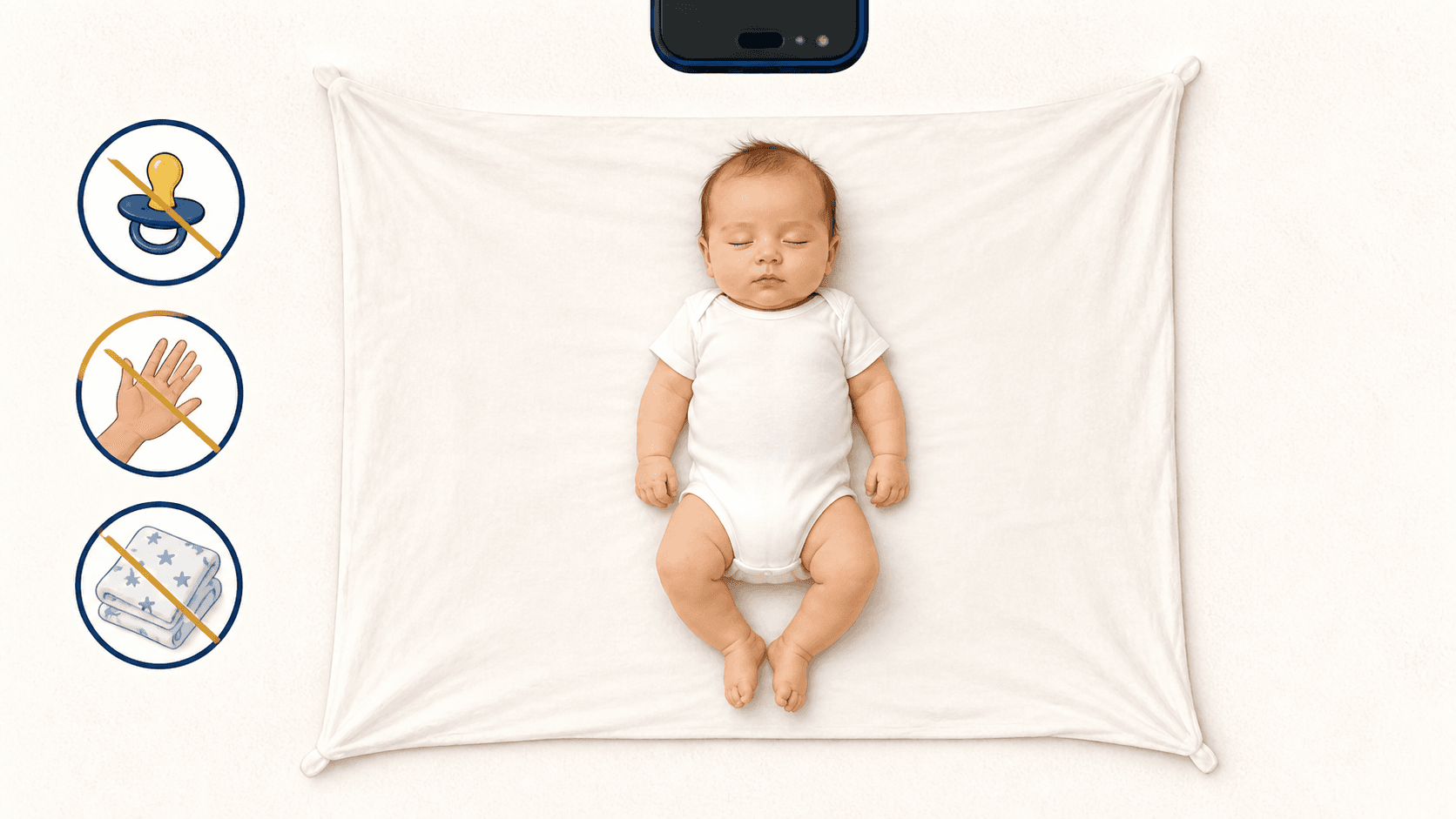
The most common baby passport photo mistakes are a visible parent or hand, a pacifier, a patterned blanket, shadows on the backdrop, motion blur, a cropped head, and a digitally whitened background. Use one of two setups — a plain white or off-white sheet on the floor, or a car seat draped with a plain white or off-white cloth — and keep the baby alone in the frame. The State Department allows one narrow flexibility for infants: the eyes do not have to be entirely open. The baby still needs to face the camera with the full face visible and a neutral expression.
Every child, including a newborn, needs their own passport for international travel. For a child under 16 applying by the standard paper process, plan on a printed 2 x 2 inch photo rather than an online-renewal upload.
Baby passport photo requirements checklist
Before you choose the final frame, confirm that:
- The baby is the only person in the photo.
- The baby faces the camera and the full face is visible.
- The background is plain white or off-white, with no pattern, texture, or distracting objects.
- There are no shadows on the face or background.
- The image is sharp and not grainy, pixelated, or motion-blurred.
- The photo is an original, unedited image taken within the last six months.
- The baby’s eyes may be partly open; for older children, follow the ordinary eyes-open requirement.
The eyes rule is not a general waiver. A pacifier, hand, blanket edge, turned head, or strong shadow can still make an otherwise promising photo unusable.
The two setups that work
The sheet method. Lay a plain white or off-white sheet flat on the floor near a bright window, pull it tight so there are no wrinkle shadows, and lay the baby on their back. Stand directly above with the camera parallel to the baby's face — a tilted angle distorts head proportions. Watch that your own shadow does not fall across the baby or the sheet.
The car seat method. For newborns without head control, cover the car seat completely with a plain white or off-white cloth and seat the baby semi-upright. Tuck the cloth so no straps, buckles, or seat pattern show anywhere in the frame. This holds the head steadier and naturally faces the baby toward the camera.
Either way, pick a moment when the baby is fed, rested, and calm. Take a short burst of photos, review them at full size, and keep the sharpest frame with the clearest view of the face. You do not need to force a perfect expression, but you do need a frame that follows the checklist.
The mistakes, and why each one fails
| Mistake | Why it fails | The fix |
|---|---|---|
| Parent's hand, arm, or lap visible | The baby must be the only person in the photo | Support the baby with the sheet or covered seat, not your hands |
| Pacifier or bottle | Objects blocking the face | Remove it just before shooting; take the shot quickly |
| Hat, bow, or headband | Head coverings and accessories | Bare head, hair out of the face |
| Patterned blanket or visible car seat | Background must be plain white or off-white | Cover everything in frame with plain cloth |
| Shadows on the sheet or face | Uneven lighting risks rejection | Use bright indirect window light; keep your shadow out of frame |
| Motion blur | The photo must be sharp | Burst mode, steady hands, lots of attempts |
| Cropped chin or top of head | The full head must be visible with room to frame | Shoot slightly wider than feels natural |
| Editing the background white | Digital changes are not allowed | Use a genuinely white backdrop and retake if it looks gray |
The last row is the tempting one. If the sheet photographs gray or yellow, the fix is more light or a whiter sheet — not an editing app. Background replacement can change the outline of the baby's head, which is exactly what reviewers examine.
What the rules actually forgive for infants
Adult passport photo rules assume a cooperative subject; the guidance acknowledges babies are not. For infants, it is acceptable if the eyes are not entirely open. That flexibility does not remove the other requirements: the baby should face the camera, show the full face, and have a neutral expression. If the mouth is open because the baby is yawning or crying, keep trying for a calmer frame.
What the rules do not forgive, at any age: another person in the frame, objects on or near the face, a non-white background, heavy shadows, blur, and digital edits. Spend your effort there rather than chasing a perfect expression.
Recency still applies — the photo must be taken within the last six months. Babies change quickly, but the photo only needs to look like your baby at application time; it does not need to survive comparison years later.
From phone photo to application
A child's first passport goes through the paper application process, so the final product is one printed 2 x 2 inch photo on matte or glossy photo-quality paper, with the head sized correctly in the frame.
Choose the sharpest original photo, then use the baby passport photo checker — it checks background, shadows, face visibility, framing, and quality for free, and the $8 output is a print-ready 4x6 sheet with two 2 x 2 photos you can print on photo paper at any photo counter. General setup tips for lighting and backgrounds are in our at-home passport photo guide.
Quick FAQ
Can I hold my baby in the photo?
No. The baby must be the only person visible, with no supporting hands in frame. Use the sheet or covered car seat instead.
Do my baby's eyes need to be open?
For infants, the State Department accepts eyes that are not entirely open. The baby should still face the camera with the full face visible. For toddlers and older children, the ordinary eyes-open requirement applies.
Can the baby be lying down?
Yes. Shooting from directly above a baby lying on a white sheet is a standard method. Keep the camera parallel to the face so the head is not distorted, and make sure the final photo shows a normal, straight-on head position.
Can a pacifier stay in for a newborn?
No. Nothing may block the face at any age. Remove it right before you shoot.
Does a newborn really need a passport?
Yes. Every person, regardless of age, needs their own passport for international travel, and children apply with the paper process — so plan on a printed photo.